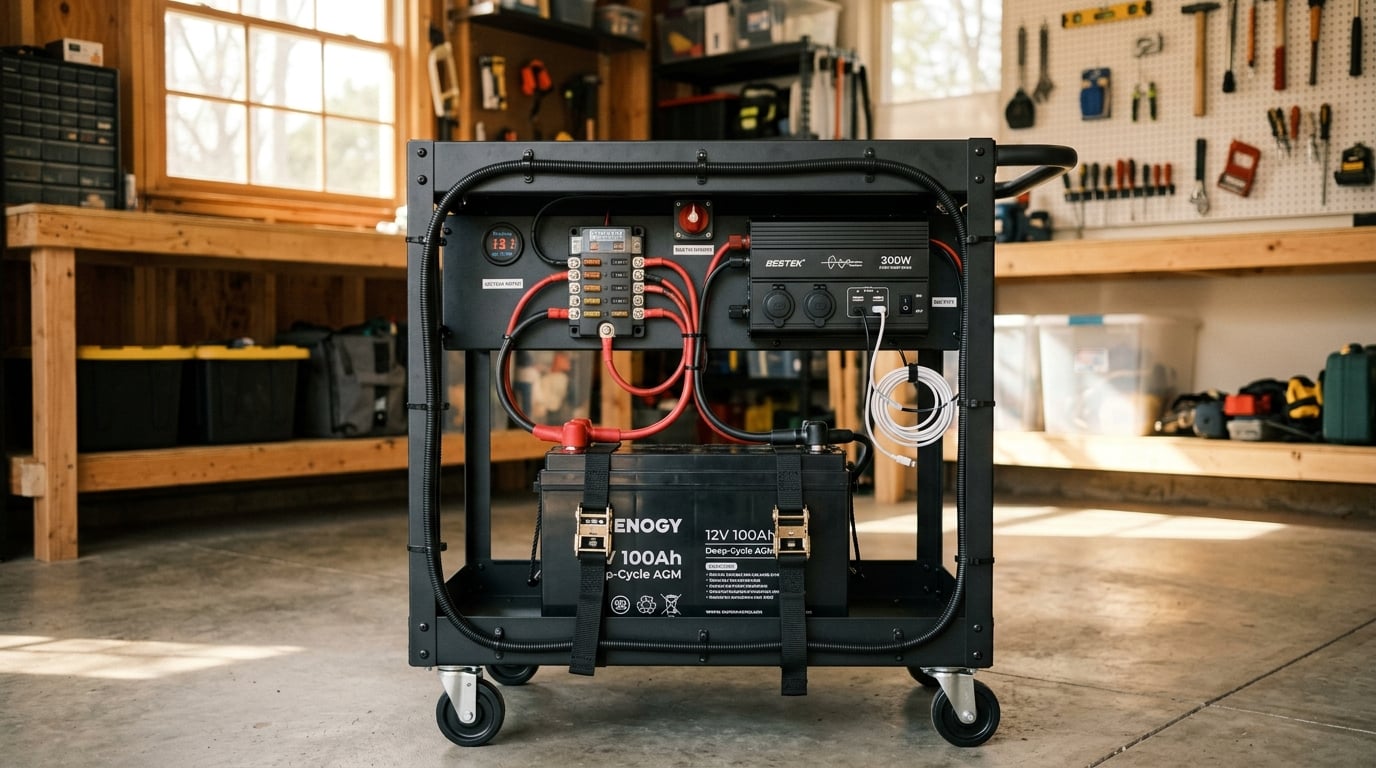
DIY 12V Blackout Battery Backup Cart
A rolling 12-volt battery station that runs lights, phones, a fan and small devices through a blackout — built from off-the-shelf parts.
A power outage does not have to mean darkness and anxiety. A simple 12-volt battery cart gives your household hours (or days) of light, phone charging, and small-appliance power — quietly, indoors, with no fumes.
This is one of the most useful and beginner-friendly energy builds you can own. Everything mounts on a small cart so you can roll power to wherever your family gathers.
What you'll need
- One deep-cycle 12V battery (AGM or LiFePO4, 50–100Ah)
- A small utility cart or hand truck with a flat base
- A 12V fuse block and inline fuses
- 12V accessory sockets and USB charging ports
- A low-wattage pure sine-wave inverter (300–600W) for small AC devices
- A compatible battery charger or a 100W solar panel with charge controller
- Ring terminals, 10-gauge wire, wire cutters and a wrench
Step by step
- 1
Secure the battery to the cart
Strap the deep-cycle battery firmly to the cart base so it cannot shift when rolled. Keep terminals facing up and accessible.
- 2
Install the fuse block
Mount a fuse block close to the positive terminal. Every circuit you add must pass through a correctly rated fuse — this is the single most important safety step.
- 3
Wire your outputs
Connect 12V sockets and USB ports to the fuse block for phones, lights and fans. These run directly off the battery and are the most efficient.
- 4
Add the inverter (optional)
For small AC devices, connect a pure sine-wave inverter directly to the battery terminals with its own fuse. Only run the inverter when needed — it draws power even when idle.
- 5
Set up charging
Add a plug-in charger to top the battery up before storms, and/or a 100W solar panel with a charge controller so you can recharge with sunlight when the grid is down.
- 6
Label and test
Label every socket, then test each output. Note roughly how many hours your typical loads run so there are no surprises during a real outage.
Safety first
Always fuse every circuit. Charge lead-acid batteries in a ventilated space. Never exceed the inverter’s rated wattage, and keep the battery away from water and children.
How this fits the 5 Pillars
This build sits squarely in the Energy pillar, but it quietly serves every other one — it keeps your water filter’s pump running, your food cold, and your household calm and connected.
Spiritual reflection
Storing up a little power before the storm is a picture of the wise life Jesus commended — the one who prepares while it is still light. Let each charge remind you to keep your own lamp filled.
“Let your light so shine before men, that they may see your good works, and glorify your Father which is in heaven.”
Matthew 5:16
Share this article
Go deeper with the Academy
These guides are a taste of the full, structured path across all five pillars of preparedness.
Join the Academy