Organic by Design: The Whole Case for Growing God’s Way
Walk into almost any garden centre and you will be handed a chemical for every problem: a spray for the weeds, a granule for the bugs, a powder for the mildew, a bright blue salt to force a quick green flush. It is offered as progress. But there is an older, wiser pattern, and it was written into creation long before any of these bottles existed.
That is the heart of our new hub page, Organic by Design. It gathers the whole argument for growing without synthetic chemicals into one honest place, and then hands you the tools to actually do it. We have now given each part its own page, so if only one of them is what you need today, you can go straight to it. Here is a tour of what you will find inside.
The Biblical Foundation
What sets this academy apart from every secular organic site is where our pattern comes from. We let the Word speak first, right on the main Organic by Design page. It walks gently through Eden as a garden we were placed in to dress it and to keep it (Genesis 2:15), the command to give the land a sabbath of rest every seventh year so the soil could recover (Leviticus 25:1-7), the caution against forcing unnatural combinations (Leviticus 19:19), and the sure principle that we reap what we sow (Galatians 6:7). Woven through it is a plain look at the Sabbath as an institution designed at creation, for all mankind, a merciful rhythm of rest. The same God who gave people a weekly rest gave the land a resting year.
The Science That Stands Beside It
To be credible, a faith claim deserves real evidence standing beside it. So this page presents the strong, mainstream research in clear, sourced cards: the underground partnership of mycorrhizal fungi and the soil microbiome, long-term trials showing organic systems match yields and do better in drought while building soil carbon, the link between certain pesticide classes and the collapse of pollinators, and human-health findings on low-level pesticide exposure. Each card names its source. We are careful here: we do not use science to prove the Bible, for science is ever changing while the Word is not. The evidence corroborates; it never anchors.
What Pesticides Actually Cost
Told soberly rather than fearfully, this page counts the true cost of the chemical road: how synthetic inputs strip soil life, run off into water, harm bees and birds, and leave residue on our food. It links to credible evidence, including research libraries such as GreenMedInfo, and then turns straight to the hopeful answer, because every cost named here has a clean alternative that works.
The Swap Guide: Ditch the Chemical, Grow It God’s Way
This is the tool many of you will use most. A searchable guide that names the common synthetic products used in farming and the food industry, from NPK fertiliser and glyphosate to neonicotinoid insecticides, fungicides and chemical preservatives, and gives the natural alternative for each: compost, companion planting, beneficial insects, cover crops, crop rotation and mulch, with a plain note on how to use it.
The Soil-Health Self-Check
Answer a few gentle questions about your ground, from how many earthworms you see to how quickly rain soaks in, then choose your soil type and climate region for advice suited to where you actually grow. You will receive faith-framed next steps that you can print or save as a PDF, links straight to the practices that will help most, and a ready-made prompt so you can ask the Storm Guide for a full, step-by-step plan. It is a friendly starting point, not a lab report, and if you would like to go deeper, one of our coaches can guide you toward a full laboratory soil test. Begin the soil-health self-check.
The Regenerative Practices Library
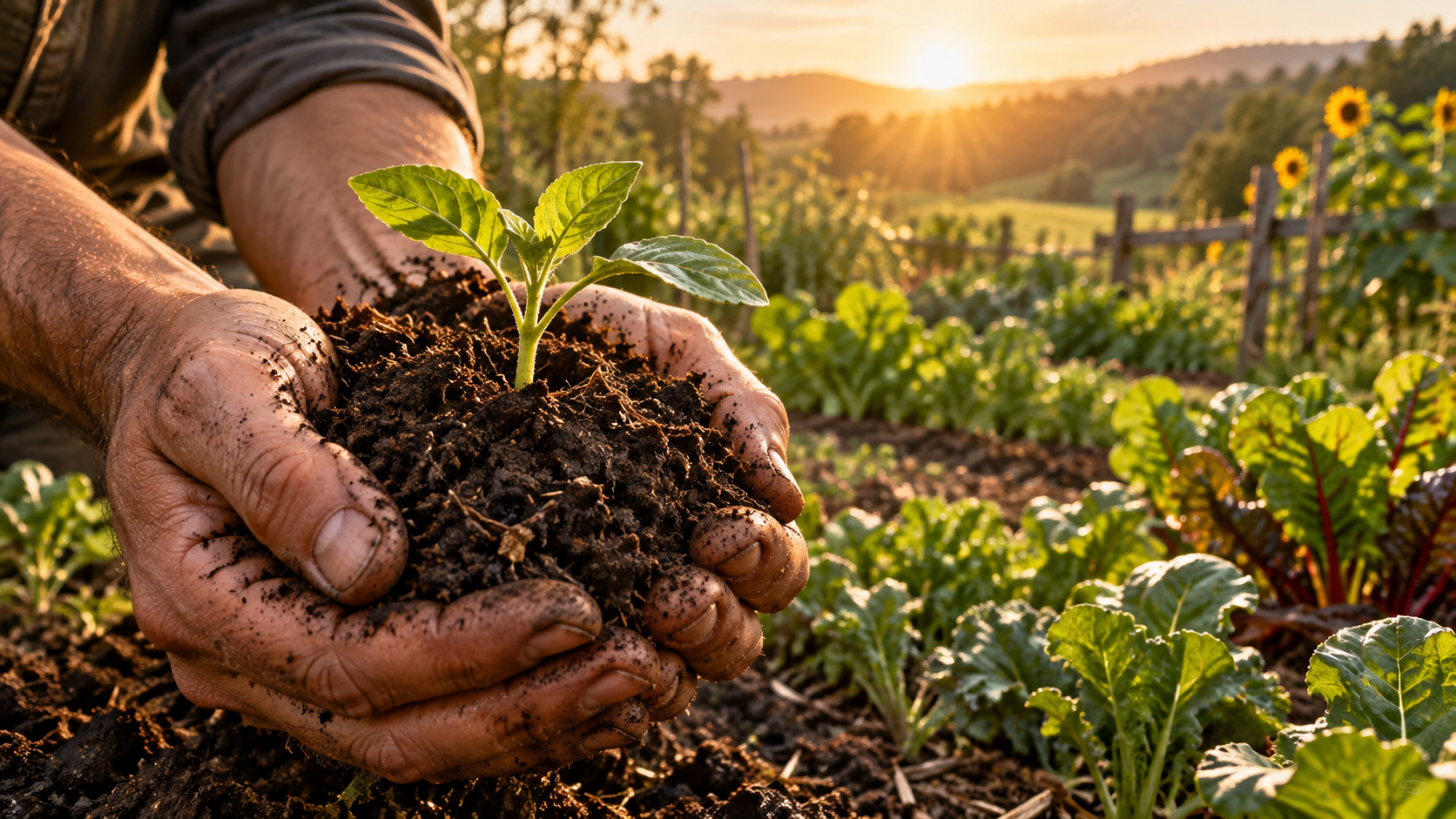
Short, practical guides to the practices that rebuild living soil at home: composting, no-dig gardening, crop rotation, cover cropping, and the ancient Sabbath-year idea of resting the land, scaled down to a single bed. Browse the practices library.
Always Ending With Something to Plant
The whole page is stitched into the rest of the academy. Every thread ends by pointing you to Heritage Seeds, the Seed Sowing Calendar and the Perennial Food Planner, so the argument always finishes with something you can actually put in the ground.
God gave the land rhythms of rest and renewal. Industrial chemistry ignores them. We simply choose to work with the grain of creation again.
"Be not deceived; God is not mocked: for whatsoever a man soweth, that shall he also reap." — Galatians 6:7
Share this article
Ready to go deeper?
Join the academy and follow a structured path across all five pillars of preparedness.